
The Evolution of Policy to Future Enforcement

In addition to describing the Agency’s current policy on time-to-event endpoints, the two guidances discussed in this article provide insights into other aspects of the Agency’s thinking. This includes the Agency’s current definitions of various trial endpoints and trial design characteristics required to support each endpoint. With that said, it is unlikely that the Agency will issue guidance discussing trial design that is specific to other therapeutic areas – at least for the foreseeable future. As companies continuously assess the shifting policy landscape and recalibrate their regulatory risk assessments in the face of the FDA’s enforcement actions, understanding the Agency’s policy on single-arm trials in the oncology space can provide valuable insights that extend to promotional claims supported by single-arm trials in other therapeutic areas.
Oncology Time-to-Event Violations: A new enforcement trend emerges
The US Food and Drug Administration’s (FDA) ongoing “crackdown” on prescription drug promotion has revealed several emerging enforcement trends, not the least of which is the Agency’s ongoing focus on time-to-event endpoints based on single-arm trials. In Part 1 of our analysis, we explored the regulatory basis for the Agency’s enforcement actions in this space. In Part 2, we look at the pattern of Agency enforcements starting with the August 2024 Untitled Letter issued to KRAZATI and examine the common violations cited by the Agency. In each enforcement letter, the approved product label for the cited product did not include a time-to-event endpoint which suggests the company intended the presentations to align with the recommendations in the Consistent with FDA-Required labeling (CFL) guidance. Based on the enforcement trend discussed in the article, it’s apparent that the Agency does not consider these types of presentations to be CFL.
The KRAZATI Untitled Letter
In August 2024, the FDA issued the first Untitled Letter citing CFL-type time-to-event presentations. The Untitled Letter cited an HCP-directed website promoting the oncology product Krazati which was approved through the accelerated approval pathway based on the outcomes of a single-arm trial. Among the multiple cited violations, the letter highlights the presentation of disease control rate as a composite of complete response, partial response, and stable disease – a policy position described in the Agency’s March 2023 guidance. The letter goes on to state the following with regard to the use of stable disease in the presentation of disease control rate:
“An assessment of delay in time to disease progression in patients treated… would need to be based on the results of a randomized controlled trial.”
Further, the website included promotional claims and graphs presenting median overall survival (OS) and progression-free survival (PFS) in addition to OS and PFS survival probability. In response, the letter states the following:
“…these claims are misleading because they are based on the results of a trial that is not capable of producing interpretable OS and PFS results.”
The Krazati letter not only includes the most thorough discussion of time-to-event violations on the part of the Agency but it also represents the start of the Agency’s enforcement of time-to-event endpoints that continues today.
A New Trend Emerges
Since August 2024, the Agency has issued over a dozen letters that cite time-to-event presentations based on single arm trials. The violations include the following:
Presentation of disease control rate as a composite of ORR (partial response + complete response) plus stable disease
Presentation of progression free survival (PFS), overall survival (OS), relapse-free survival (RFS), or disease-specific survival (DSS) as either median survival time or probability of survival
Presentation of progression free survival and/or overall survival through graphs either in conjunction with a Kaplan-Meier presentation or a waterfall plot
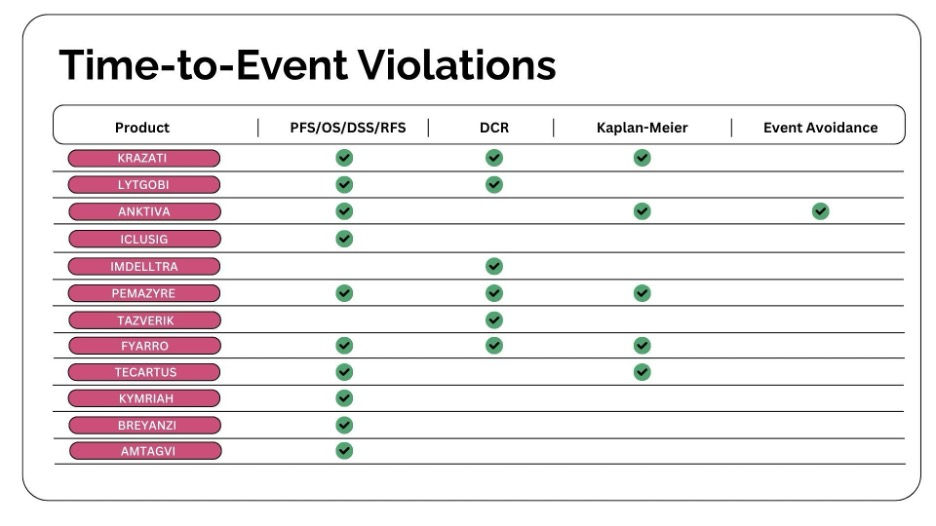
In each letter, the Agency states that the presentations are misleading because the study from which the representations were drawn could not demonstrate the presented results.
Further, the letters state that time-to-event results from a single-arm trial are uninterpretable. Presentations based on an assessment of delay in time to disease progression (i.e. stable disease) could only be supported by results from a randomized controlled trial. Specifically, the Agency states “absent an appropriate comparator, it is not possible to determine if the observed effect is attributable to [treatment] or to other factor(s), such as the natural history of the disease.”
What can regulatory teams do to reduce the risk of an enforcement letter?
Oncology products approved without a randomized controlled trial should avoid promotional claims and presentations that cannot be supported by their clinical trial design
Use caution when applying the Consistent with FDA-Required Labeling (CFL) guidance – while a presentation may pass the CFL three-factor analysis, presentations that rely on a study that is inadequate to support the representations in the communication are not consistent with CFL recommendations
While not cited in recent enforcement letters, OPDP called out the use of pooled data in the August 2024 KRAZATI enforcement letter. Companies should use caution when presenting pooled data as these analyses are subject to internal validity and interpretability limitations due to differences across studies. The Agency noted in the August 2024 letter that pooled data can be impacted by trial heterogeneity in results that confound interpretation.
While the time-to-event enforcement letters issued to date have been directed toward Oncology products approved through single-arm trials, firms marketing any product approved through a single-arm trial should take note of this continuing enforcement trend and reassess their CFL-type promotional presentations based on the violations cited by the Agency.


Comments